Tuesday, May 5, 2015


Sunday, February 22, 2015
Shk. Al-Fawzaan on Interacting or Boycotting various Islamic groups
Should the various Islamic groups be boycotted or interacted with?
Shaykh Saalih ibn Fawzaan al-Fawzaan
Reference: Beneficial Answers to Questions Relating to New Methodologies
Question: Is it permitted to mix with the various groups or should they be boycotted?
Response: Mixing with them, if it is done for the purpose of Da’wah – from those who have knowledge and insight – to holding firm to the Sunnah and leaving off the errors – then this is good. This is Da’wah to Allaah. As for if the mixing with them is for mere socialising or accompanying them without any Da’wah or clarification then this is not permitted.
It is not permitted for a person to mix with those who oppose [the Sunnah] except in a manner which brings about a legislated benefit, such as calling them to the correct Islaam or clarifying the truth to them so they may return to the truth. Just as Ibn Mas’ood went to the innovators who were in the Masjid and stayed with them and disapproved of their innovations.
Also Ibn Abbaas (may Allaah be pleased with them both) went to the Khawaarij and debated them, clarified their doubts and so some among them returned [to the truth].
So if mixing with [the groups] is done in this way, then it is required; but if they persist upon their falsehood then it becomes obligatory to stay away from them, become distant and strive against them for the sake of Allaah.
هل تُخَالَط الجماعات أم تُهجر؟
المرجع: كتاب الأجوبة المفيدة عن أسئلة المناهج الجديدة
السؤال:هل تُخَالَط الجماعات أم تُهجر ؟
الجواب: المخالطة إذا كان القصد منها دعوتهم
– ممن عندهم علم وبصيرة- إلى التمسك بالسنة، وترك الخطأ فهـذا طّيِب، وهو
من الدعوة إلى الله، أما إذا كان الاختلاط معهم من أجل المؤانسة معهم،
والمصاحبة لهم، بدون دعوة، وبدون بيان؛ فهذا لا يجوز . فلا يجوز للإنسان أن
يخالط المخالفين إلا على وجه فيه فائدة شرعية، من دعوتهم إلى الإسلام
الصحيح، وتوضيح الحق لهم لعلهم يرجعون
كما ذهب ابن مسعود – – إلى المبتدعة الذين في المسجد، ووقف عليهم، وأنكر عليهم بدعتهم .
وابن عباس – رضي الله عنهما – ذهب إلى الخوارج، وناظرهم، ودحض
شبههم، ورجع منهم من رجع . فالمخالطة لهم إذا كانت على هذا الوجه فهي
مطلوبة، وإن أصروا على باطلهم وجب اعتزالهم ومنابذتهم، وجهادهم في الله .
Shk Zayd Ibn Muhammad al Madkhalee
Shk Zayd Ibn Muhammad al Madkhalee
Tuesday, September 30, 2014
Closing Comments
As salaamu alaykum wa Rahmatullahi wa Barakatuh.
To those of you who have posted questions in the past few months and not had a response, we apologize. We have been away from Madinah for three months at our farm and future Islamic educational retreat, Healing Earth wa al hamdul'Illah. Quite honestly, we don't have the time to keep up with the questions and won't be responding to anymore emails. In addition, what we have found is that most of the questions are things that are already written about somewhere in this blog.
Most of the information herein is still valid, although prices and locations of places may and do change from time to time. Al hamdul'Illah, there is more information on the Internet about shops and places in Madinah than before, so prices of food and goods from Hyperpanda, Carrefour, Watania Organic, Jarir Bookstore, and others can be found online. Aside from expansion changes, all the basic information about Masjid un Nabawi is the same inshaa Allah. Housing prices may creep up, but we still have relatively realistic prices quoted on the blog posts about housing that can be used as a guideline. Schools have not improved to any extent, but there are listings of schools in Madinah that can be found and small, local ones do keep popping up.
We will be closing comments on this blog and will no longer be posting information herein. As we are in our final 8 months here in Madinah, prior to returning to develop our farm, build a masjid and Islamic retreat at Healing Earth, we will be busy focusing on intensive Arabic and preparations prior to leaving. If you are seeking information about living in Madinah, please do read through the posts of this blog completely. We have found that nearly every question asked of us has already been addressed on the blog, but people haven't read through it.
We pray Allah blesses you all in your efforts to draw closer to Him and worship Him and wish you all the Ultimate Success in this life and the Aakhirah - AMEEN!
To those of you who have posted questions in the past few months and not had a response, we apologize. We have been away from Madinah for three months at our farm and future Islamic educational retreat, Healing Earth wa al hamdul'Illah. Quite honestly, we don't have the time to keep up with the questions and won't be responding to anymore emails. In addition, what we have found is that most of the questions are things that are already written about somewhere in this blog.
Most of the information herein is still valid, although prices and locations of places may and do change from time to time. Al hamdul'Illah, there is more information on the Internet about shops and places in Madinah than before, so prices of food and goods from Hyperpanda, Carrefour, Watania Organic, Jarir Bookstore, and others can be found online. Aside from expansion changes, all the basic information about Masjid un Nabawi is the same inshaa Allah. Housing prices may creep up, but we still have relatively realistic prices quoted on the blog posts about housing that can be used as a guideline. Schools have not improved to any extent, but there are listings of schools in Madinah that can be found and small, local ones do keep popping up.
We will be closing comments on this blog and will no longer be posting information herein. As we are in our final 8 months here in Madinah, prior to returning to develop our farm, build a masjid and Islamic retreat at Healing Earth, we will be busy focusing on intensive Arabic and preparations prior to leaving. If you are seeking information about living in Madinah, please do read through the posts of this blog completely. We have found that nearly every question asked of us has already been addressed on the blog, but people haven't read through it.
We pray Allah blesses you all in your efforts to draw closer to Him and worship Him and wish you all the Ultimate Success in this life and the Aakhirah - AMEEN!
Friday, June 20, 2014
Praying and Teaching in the Mosques of the Soofees
Shaykh Abdul Azeez Ibn Baaz
Reference: http://www.binbaz.org.sa/mat/15983
Question:
There exists a Masjid in our area that has been built by a group from
the Soofiyyah. This was after we – Ahlus Sunnah – wanted to build it,
however they insisted on building it and so they did. The Masjid is
under their administration and control. They hold sessions of poetry and
praises in the Masjid.
Is it permissible for us – the Sunnis –
to pray in this Masjid with them and also pray behind their Imaam who is
an innovator, or what else can we do?
Response:
If their Imaam is not a disbeliever, and he only has with him some
innovations that do not necessitate a person to be exited from Islaam,
then there is nothing preventing one from praying with them as well as
advising, educating and teaching them by calling them to Allaah after
the prayers. Also [there is no problem] in circles of knowledge in the
Masjid so the people benefit, learn and leave the innovations they have
with them – inshaaAllah. This is from cooperating upon righteousness and
Taqwa (piety) and also from the avenue of advising each other.
If, however, the Imaam performs that
which necessitates disbelief, such as the person who seeks deliverance
and rescue from Prophet (sal Allaahu alayhi wa sallam), supplicates to
other than Allaah, seeks rescue from the deceased, makes oaths and vows
by them or sacrifices in their name then this is disbelief and
misguidance. These actions are acts of disbelief and so it is not
permissible to pray behind such a person. This is because these actions
are acts of disbelief in Allaah (the Exalted) and polytheism.
Similar to this is if their Imaam
possesses a creed of disbelief, like the one who believes that the
righteous people are able to effect creation other than Allaah and that
they control the worlds. This is similar to what some of the Soofiyyah
say. Also [if the Imaam] possesses the belief of those people who
believe in the unity of creation, whereby they say that the Creator and
creation are one; the Creator and creation, the worshipper and the One
worshipped are one in unity; and other false notions of disbelief – the
one who possesses such beliefs is a disbeliever and one is not to pray
behind him.
As for the innovations that are less than
disbelief then it is permissible to pray behind him. For example the
innovation of celebrating the birthday of the Prophet (sal Allaahu
alayhi wa sallam), it is not disbelief. Also some of the other
innovations that the Soofees partake in that do not contain aspects of
disbelief, rather they are less than disbelief and so praying behind
them cannot be prohibited.
As for the poetry that they come with, then
it is to be analysed. So if it contains disbelief like the poetry of the
one who wrote the Burdah, [1] wherein he said:
Most generous of mankind, I have no one to take refuge in;
Except you at occurrence of widespread calamity.
Except you at occurrence of widespread calamity.
If you do not take my hand out if kindness on the Day of Resurrection,
then what great trouble I will be in
then what great trouble I will be in
For verily amongst your bounties is this world, and the hereafter.
And part of your knowledge is knowledge of the Preserved Tablet (Lowh), and the Pen.
And part of your knowledge is knowledge of the Preserved Tablet (Lowh), and the Pen.
Whenever time caused me any distress and I took refuge in him.
I receive shelter from him which was not misused.
I receive shelter from him which was not misused.
These verses of poetry contain disbelief
and this is a misguided belief. So if those in the Masjid believe
similar to these affairs then the prayer is not fulfilled behind their
Imaam. This is because the belief that the Messenger of Allaah (sal
Allaahu alayhi wa sallam) knows the unseen or that he has control over
this world and the Hereafter is disbelief and misguidance – refuge is
sought in Allaah. The knowledge of the unseen is only known to Allaah
(Glorified and the Most High).
Similar to this is the belief of some of
the Soofees and polytheists who believe that the Messenger of Allaah
(sal Allaahu alayhi wa sallam) is able to rescue people on the Day of
Resurrection and that he is able to recue the one who supplicates to him
on the Day of Resurrection from the Fire. This is disbelief and
misguidance.
All the affairs are in the Hands of
Allaah (Glorified and the Most High); He is the one who saves from the
Fire; He is the one who has knowledge of the Unseen; He is the one who
possesses sovereignty and controls all the affairs – May He be Glorified
the Most High.
The Messenger (sal Allaahu alayhi wa
sallam) does not possess the ability to exit people from the Fire; he is
able to plead intercession, and Allaah has availed him a limited
opportunity to intercede on the Day of Resurrection. He will only
intercede for the people of Tawheed and Imaan (Faith).
Abu Huraira (may Allaah be please with him) said,
O Messenger of Allaah, who are the people truly deserving of your intercession?
He replied,
Whomsoever declared ‘Laa ilaaha illa Allaah’ sincerely from his heart
or he said,
sincerely from his self
He (sal Allaahu alayhi wa sallam) also said,
I have delayed my supplication [so I may seek] intercession for my nation on the Day of Resurrections. It will be achieved – Allaah willing – by the one who dies from my nation and does not associate any partners to Allaah
In conclusion, if the Imaam has aspects
of disbelief with him, then he is not to be prayed behind. As for if his
innovations are less than disbelief then there is nothing preventing
the prayer behind him.
However if there is another Masjid
wherein Ahlus Sunnah are present, then it is better and preferred to
pray therein; it is also more distanced from any evil.
At the same time, however, Ahlus Sunnah
should remain in contact with People of Innovation (Ahl al-bid’ah) in
order to advise, direct, educate and give them understanding of the
religion; cooperating with them upon goodness and Taqwa (piety).
This is because some of the people of
innovation may be ignorant and lack insight, so if he was to know the
truth he would accept it and leave alone the innovation. Therefore Ahlus
Sunnah should remain in contact with the people of innovation in order
to advise, direct and teach them the Sunnah, as well as warning them
from innovations.
This is the obligation upon the people of knowledge and faith. This is due to the saying of Allaah,
{Invite to the Way of your Lord
with wisdom fair preaching, and argue with them in a way that is better.
Truly, your Lord knows best who has gone astray from His Path, and He
is the Best Aware of those who are guided} [16:125]
Also, the saying of Allaah,
{And who is better in speech than
he who says: “My Lord is Allaah (believes in His Oneness)” and then
stands straight (acts upon His Order), and invites to Allaah and does
righteous deeds, and says: “I am one of the Muslims} [41:33]
We ask Allaah to grant guidance to everybody.
الصلاة مع الصوفية أصحاب الموالد
المرجع: http://www.binbaz.org.sa/mat/15983
السؤال:
في حيّنا مسجد بناه جماعة من الصوفية، بعد أن أردنا نحن – أهل السنة –
بناءه، ولكنهم أصروا على بنائه وفعلوا، وهو الآن تحت إدارتهم وتصرفهم،
ويقومون فيه بأشعار ومدائح، فهل يجوز لنا نحن السُنيين أن نصلي فيه معهم
وخلف إمامهم المبتدع أم ماذا نفعل؟
الجواب:
إذا كان إمامهم ليس بكافر وإنما عنده بعض البدع التي لا تخرجه من الإسلام،
فلا مانع من الصلاة معهم ونصيحتهم وتوجيههم وإرشادهم بالدعوة إلى الله بعد
الصلوات، وفي حلقات العلم في المسجد حتى يستفيدوا وينتفعوا ويدعوا ما
عندهم من البدع إن شاء الله، لأن هذا من باب التعاون على البر والتقوى ومن
باب التناصح،
أما إن كان إمامهم يتعاطى ما
يوجب كفره، كالذي يستغيث بالرسول – صلى الله عليه وسلم – أو يدعوه من دون
الله، أو يستغيث بالأموات وينذر لهم ويذبح لهم، هذا كفر وضلال، هذه أمور
كفرية لا يصلى خلفه، لأن هذه الأمور من الأمور الكفر بالله والشرك بالله –
عز وجل،
وهكذا إذا كان إمامهم يعتقد
اعتقادات كفرية، كأن يعتقد أن غير الله يتصرف في الكون من الأولياء، وأنهم
يدبرون هذا العالم، من الأولياء كما يفعله بعض الصوفية، أو يعتقدون ما
يعتقده أصحاب وحدة الوجود بأن الخالق والمخلوق واحد، الخالق والمخلوق
والعبد والمعبود ونحو ذلك من المقالات الخبيثة الملحدة فهذا كافر ولا يصلى
خلفه،
أما إذا كانت بدع دون الكفر فإن
هذا يصلى خلفه، مثل بدعة المولد وليس فيها كفر، مثل بعض البدع الأخرى التي
يفعلها الصوفية وليست بكفر، بل دون الكفر فلا تمنع من الصلاة خلفه،
وأما الأشعار التي يأتي بها ينظر فيها فإن كانت أشعاراً كفرية مثل أشعار صاحب البردة في قوله:
يا أكرم الخلق ما لي من ألوذ
بسواك عند حلول الحادث العمم
إن لم تكن بمعادي آخذاً بيدي
فضلاً وإلا فقل يا زلة القدم
فإن من جودك الدنيا وضرتها
ومن علومك علم اللوح والقلم
بسواك عند حلول الحادث العمم
إن لم تكن بمعادي آخذاً بيدي
فضلاً وإلا فقل يا زلة القدم
فإن من جودك الدنيا وضرتها
ومن علومك علم اللوح والقلم
هذه أشعار كفرية، هذا اعتقادٌ ضال، فإذا
كان أصحاب المسجد يعتقدوا مثل هذه الأمور فلا يصلى خلف إمامهم، لأن
الاعتقاد بأن الرسول – صلى الله عليه وسلم- يعلم الغيب، أو أنه يملك الدنيا
والآخرة هذا كفرٌ ولا ضلال والعياذ بالله، لأن علم الغيب لا يعلمه إلا
الله – سبحانه وتعالى -،
وهكذا اعتقاد بعض الصوفية وبعض الوثنية أن
الرسول – صلى الله عليه وسلم- ينقذ الناس يوم القيامة، وينقذ من دعاه يوم
القيامة ويخرجه من النار، هذا كله كفرٌ وضلال، إنما الأمور بيد الله –
سبحانه وتعالى -، هو الذي ينجي من النار، وهو الذي يعلم الغيب، وهو مالك
لكل شيء، والمدبر للأمور- سبحانه وتعالى
-، والرسول – صلى الله عليه وسلم- ليس بيده
إخراج الناس من النار، بل يشفع ويحد الله له حداً يوم القيامة في الشفاعة
عليه الصلاة والسلام، ولا يشفع إلا لأهل التوحيد والإيمان، كما قد سأله أبو
هريرة- رضي الله عنه – قال يا رسول الله: ((من أحق الناس بشفاعتك؟ )) قال:
((من قال لا إله إلا الله خالصاً من قلبه، أو قال: خالصاً من نفسه)، وقال
عليه الصلاة والسلام: (إني اختبأت دعوتي شفاعة لأمتي يوم القيامة فهي
نائلةٌ إن شاء الله، من مات من أمتي لا يشرك بالله شيئاً)) فشفاعته لأهل
التوحيد والإيمان لا لأهل الكفر بالله – عز وجل -.
فالحاصل أن الإمام إذا كان عنده شيءٌ من
الكفر هذا لا يصلى خلفه، أما إذا كانت بدعته دون الكفر فلا مانع من الصلاة
خلفه، ولكن إذا وجد مسجدٌ آخر فيه أهل السنة فالصلاة خلفهم أولى وأحسن
وأبعد عن الشر، ولكن مع ذلك ينبغي لأهل السنة أن يتصلوا بأهل البدع للنصيحة
والتوجيه والتعليم والتفقيه والتعاون على البر والتقوى، لأن بعض أهل البدع
قد يكونوا جاهلاً ما عنده بصيرة، فلو علم الحق لأخذ به وترك بدعته.
فينبغي لأهل السنة أن لا يدعوا أهل البدع،
بل عليهم أن يتصلوا بهم وينصحوهم ويوجهوهم ويعلموهم السنة ويحذروهم من
البدعة، لأن هذا هو الواجب على أهل العلم والإيمان، كما قال الله – سبحانه
وتعالى -:
{ادْعُ إِلِى سَبِيلِ رَبِّكَ بِالْحِكْمَةِ وَالْمَوْعِظَةِ الْحَسَنَةِ وَجَادِلْهُم بِالَّتِي هِيَ أَحْسَنُ} (125) سورة النحل،
وقال – سبحانه وتعالى -:
{وَمَنْ أَحْسَنُ قَوْلًا مِّمَّن دَعَا إِلَى اللَّهِ وَعَمِلَ صَالِحًا وَقَالَ إِنَّنِي مِنَ الْمُسْلِمِينَ} (33) سورة فصلت.
نسأل الله للجميع التوفيق الهداية.
Entering into churches in order to call to Islaam
Reference: Fataawa al-Lajnah ad-Daaimah
Question: What is the ruling on a Muslim entering a church to observe their prayers or listen to a lecture?
Question: What is the ruling on a Muslim entering a church to observe their prayers or listen to a lecture?
Response:
It is impermissible for a Muslim to enter upon disbelievers in their
places of worship since it increases their numbers. In addition,
al-Baihaqee has reported with an authentic chain of narrators that ‘Umar
(may Allah be pleased with him) said, “…And do not enter upon the
idolaters in their churches and temples, for anger descends upon them.”
However, if [one enters their churches]
for a legislative benefit, or to call them to Allah, or something along
those lines, then there is no harm in doing so.
And success is with Allah alone.
May peace and blessings be upon our Prophet Muhammad, his family and companions.
Signed: Abdul-Aziz bin Abdillah bin Baz
(president), Abdurrazzaq ‘Afeefi (vice-president), Abdullah bin Ghudayan
(member), Abdullah bin Qu’ood (member).
***
Question:
There exist many churches here, is it therefore permitted to enter into
them and to debate the clergymen? Is it permitted to enter into them in
order to look around and know what they do?
Response:
It is permissible for people of knowledge to enter churches in order to
invite the people there to Islam. However, entering them just to look
around should be avoided, because there is no benefit in doing so.
True Guidance is from Allaah; may peace and blessings be upon our Prophet Muhammad, his family and companions.
دخول معابد الكفار
المرجع: فتاوى اللجنة الدائمة
السؤال:ما حكم دخول المسلم إلى الكنيسة سواء لحضور صلاتهم أو الاستماع إلى محاضرة.
الجواب:
لا يجوز للمسلم الدخول على الكفار في معابدهم؛ لما فيه من تكثير سوادهم،
ولما روى البيهقي بإسناد صحيح عن عمر رضي الله عنه قال: (… ولا تدخلوا على
المشركين في كنائسهم ومعابدهم فإن السخطة تنزل عليهم) لكن إذا كان لمصلحة
شرعية أو لدعوتهم إلى الله ونحو ذلك فلا بأس.
وبالله التوفيق. وصلى الله على نبينا محمد، وآله وصحبه وسلم.
***
السؤال: توجد هنا كنائس كثيرة، فهل يجوز الدخول فيها ومناقشة القساوسة الذين فيها؟ هل يجوز دخولها للنظر فيها ومعرفة ما يفعل هؤلاء؟
الجواب: يجوز
الدخول في الكنائس لأهل العلم لدعوة أهلها إلى الإسلام، أما دخولها لأجل
الفرجة فقط فلا ينبغي؛ لأنه لا فائدة من ورائه، ولأنه يخشى على المسلم أن
يتأثر بهم، لا سيما إذا كان جاهلاً بأمور دينه، ولا يستطيع رد الشبهة التي
يوجهونها إليه.
وبالله التوفيق وصلى الله على نبينا محمد وآله وصحبه وسلم.
Monday, February 3, 2014
Praying in Masjid an Nabawi for Women
Bism Illah wa assalaamu alaykum wa Rahmatullahi wa Barakatuh.
Many of you may not realize that although we live in Madinah, our girls and I rarely go to Masjid an Nabawi to pray. In fact, aside from Eid prayers for which it is clearly legislated that the women attend, we usually don't go at all. The reason for this is that the best place for a woman to pray is her home. It reaps the best reward and to that end, I am copying an excerpt from the book My Home, My Path, from the section titled, "The Role of the Woman in the Raising and Education of the Family," by Sheikh Saalih al-Fawzaan, may Allah preserve him.
Many of you may not realize that although we live in Madinah, our girls and I rarely go to Masjid an Nabawi to pray. In fact, aside from Eid prayers for which it is clearly legislated that the women attend, we usually don't go at all. The reason for this is that the best place for a woman to pray is her home. It reaps the best reward and to that end, I am copying an excerpt from the book My Home, My Path, from the section titled, "The Role of the Woman in the Raising and Education of the Family," by Sheikh Saalih al-Fawzaan, may Allah preserve him.
"The congregational prayers in the masjid are Islamically legislated as the realm of the men, and from the best of their actions, and how much better if it is in the masjid of Allaah's Messenger, praying with him, may Allaah's praise and salutations be upon him. And yet, in spite of all this, he used to encourage the women to pray in their houses.
It is narrated from the wife of Abi Humaid as-Saa'idee,. that she went to the Messenger of Allah, may Allaah's praise and salutations be upon him, and said, "Oh, Messenger of Allaah, truly I love praying with you." So he replied, {I know that you love to pray with me, and your prayer in (an inner room) your house is better than your prayer in your outer room, and your prayer in your outer room is better than your prayer in your residence and your prayer in your residence is better than your prayer in the masjid of your people, and your prayer in the masjid of your people is better than your prayer in my masjid.} So she ordered a masjid to be built for her in the darkest and most private part of her house, and she prayed in it until she met her Lord, Glorified and Exalted is He. (The hadeeth is found in Ahmad 6/371, and Ibn Khuzaimah in his "Saheeh" 3/95 and it is hasan. Look in "Saheeh Ibn Khusaimah")
So the suggestion of the hadeeth is clear, in that the fundamental situation is that the woman stays in her home, so much so that the benefit of the prayer in her house is greater than the benefit of the prayer in his masjid with the Messenger of Allaah, may Allah's praise and salutations be upon him - yet in spite of that he did allow the woman to go out to the masjid."
Friday, January 31, 2014
Winter...Brrrr and Phew!
Just so you know, when winter comes it can get quite cold here in Madinah. However, once you get out your sweaters, warmer clothes, and light jackets the weather will turn warm again and you will find yourself sweating. It is much safer to wear layers, so you can shed the cardigan or sweater if you need to cool down. Even though we had some rain this past three days, the temperatures were still very warm and the usual days are still around 70-80 degrees Fahrenheit when the sun is at it's zenith. So, simply put, prepare to shiver for a few days, and sweat for others on and off throughout the winter months...and don't get excited at the first cool days and think that the cold weather is there to stay for the winter months.
Al hamdul'Illah for the blessing of coolness and rain in these months!
Al hamdul'Illah for the blessing of coolness and rain in these months!
Moving again
Bism Illah wa assalaamu alaykum wa Rahmatullahi wa Barakatuh.
It is a common thing here to have to move, even if you are comfortable in your home. We know of people whose landlord just told them that they wanted the place for someone else and they had to leave. Our landlord informed us that he wants to build on our roof, so by April we would have to move. In any case, we found several very nice apartments here in Aziziya, all within SAR 20,000 to 25,000. However, we ended up renting a brand new, 5 bedroom, 3 bath apartment for SAR 25,000. It has a two entrances, a men's majlis, women's majlis, kitchen, and 5 rooms that can be used as bedrooms or, in our case 3 bedrooms, a school room, and a play room. Al hamdul'Illah.
Saturday, January 11, 2014
Books
Bism Illah wa assalaamu alaykum wa Rahmatullahi wa Barakatuh.
Many people assume that living in Saudi Arabia, and particularly Madinah, means that all the books available here are Islamically correct and compliant. However, that is far from the case. There are wonderful collections of ahadeeth and Islamic texts that are all used by the Jami'ah students and scholars for reference, but there are many others that are incorrect, unchecked, and deviant.You either need to know your books, so you can purchase those that will truly be beneficial knowledge, or ask someone to advise you what to buy. That said, Islamic books are well worth buying here - particularly if you are buying Arabic ones or from Darussalam - as they are cheaper and the selection is exhaustive maashaa Allah.
When it comes to English books and fiction, it is quite a different story. There are Arabic translations of the totally unsuitable and un-Islamic Twilight series, Harry Potter, and more. The same books, as well as others dealing with Western families with divorce, boyfriends, and various other typical subjects, are available in English. In addition, there majority of books have pictures, images, photos, and can even be of Christian influence. We have seen children's Islamic books that talk about Muslim children doing ballet, having Christmas decorations, and celebrating secular holidays. It is not easy to find a good variety of non-fiction books for children and young adults here and many of the school and story books have spelling and/or grammar errors.
Should you want to order books, the place we use the most is The Book Depository. They ship worldwide for free and we have always received our shipments, maashaa Allah. You can find a very good collection of books there, usually cheaper than buying them here, and can select books more suited to your needs. Of course, there is always Amazon.com as well, but you have to pay shipping for the books, which can be very expensive.
Barak Allahu feekum.
Many people assume that living in Saudi Arabia, and particularly Madinah, means that all the books available here are Islamically correct and compliant. However, that is far from the case. There are wonderful collections of ahadeeth and Islamic texts that are all used by the Jami'ah students and scholars for reference, but there are many others that are incorrect, unchecked, and deviant.You either need to know your books, so you can purchase those that will truly be beneficial knowledge, or ask someone to advise you what to buy. That said, Islamic books are well worth buying here - particularly if you are buying Arabic ones or from Darussalam - as they are cheaper and the selection is exhaustive maashaa Allah.
When it comes to English books and fiction, it is quite a different story. There are Arabic translations of the totally unsuitable and un-Islamic Twilight series, Harry Potter, and more. The same books, as well as others dealing with Western families with divorce, boyfriends, and various other typical subjects, are available in English. In addition, there majority of books have pictures, images, photos, and can even be of Christian influence. We have seen children's Islamic books that talk about Muslim children doing ballet, having Christmas decorations, and celebrating secular holidays. It is not easy to find a good variety of non-fiction books for children and young adults here and many of the school and story books have spelling and/or grammar errors.
Should you want to order books, the place we use the most is The Book Depository. They ship worldwide for free and we have always received our shipments, maashaa Allah. You can find a very good collection of books there, usually cheaper than buying them here, and can select books more suited to your needs. Of course, there is always Amazon.com as well, but you have to pay shipping for the books, which can be very expensive.
Barak Allahu feekum.
Thursday, December 26, 2013
Our Apologies
As salaamu alaykum wa Rahmatullahi wa Barakatuh.
This blog was set up so that people who wanted information about living in Madinah and what to expect upon arrival here. It was never intended as a job finding service, a database for salaries, or a resource for government regulations and requirements to set up businesses. Neither is it intended as a resouce for finding spouses in or out of Saudi Arabia.
As Shariyf works at Taibah University and has many friends in the Jami'at ul Islamiyyah, he has provided information about them when asked, to the best of his ability. However, he doesn't have any knowledge or information on other types of jobs and cannot get people jobs in Taibah University.
We will try to provide more details on life here and various developments, but please don't send us questions or requests for assistance in getting employment, starting up a business here, or to find you a wife or husband, as we cannot help you. Please accept our apologies for our shortcomings and we pray that you will all benefit in some way from this humble effort on our part to fill an information gap.
Barak Allahu feekum.
This blog was set up so that people who wanted information about living in Madinah and what to expect upon arrival here. It was never intended as a job finding service, a database for salaries, or a resource for government regulations and requirements to set up businesses. Neither is it intended as a resouce for finding spouses in or out of Saudi Arabia.
As Shariyf works at Taibah University and has many friends in the Jami'at ul Islamiyyah, he has provided information about them when asked, to the best of his ability. However, he doesn't have any knowledge or information on other types of jobs and cannot get people jobs in Taibah University.
We will try to provide more details on life here and various developments, but please don't send us questions or requests for assistance in getting employment, starting up a business here, or to find you a wife or husband, as we cannot help you. Please accept our apologies for our shortcomings and we pray that you will all benefit in some way from this humble effort on our part to fill an information gap.
Barak Allahu feekum.
Friday, December 13, 2013
Umrah in Muharram/over Aashoorah
Bism Illah wa assalaamu alaykum wa Rahmatullahi wa Barakatuh.
Going to Umrah from Madinah is pretty much a straight road for 4 of the 4.5 to 5 hour drive. There is, midway, a rest stop that is quite new and very popular as it has fast food franchises of Burger King, Baskin Robbins, Al Baik, Barnies, and more. Of course, there is a masjid there and the bathrooms are large and decent compared to many others along the way.
While we have driven for all the past Umrah trips we made, there is a VIP coach service to Makkah run by SAPTCO, which we used this last time. The booking office is beside Elaf Taibah Hotel and the bus leaves from in front of the hotel. There are three departure times a day, one in the morning, one in the early evening, and one at night. The cost round trip is 180 riyaal ($48) per adult, 90 riyaal ($24) per child, 12 and under.
The coach is large, spacious, with a built in table in front of each set of seats and power outlets underneath. There is a bathroom on the bus and they provide a meal for the journey followed by tea or coffee. The meal on our outbound journey from Madinah was chicken nuggets, potato wedges, salad, an apple, a fruit drink, and water. It is a non-stop service, however on the way the Makkah it stops at the meeqaat for 15 minutes. The meal on our return journey was a Kudo chicken sandwich, a can of soda, tea or coffee. It is a very comfortable ride, which enables one to relax, take a nap, and arrive in Makkah rested and in great shape to perform Umrah. This is quite the contrary to driving, where after a 5 hour drive, one is inevitably tired both physically and mentally. It is also a far better option than taking a taxi, which is usually crammed full of people and puts your life on the line as the driver travels as breakneck speed getting some people there in just 3 hours.
In the aftermath of the amnesty for illegal residents, there were vigorous raids to catch the illegals that stayed. On arrival at our hotel, we were told by the receptionist that they were closed because all the workers had run away! This was due to fear of being caught by the authorities, the result of which would be imprisonment, a hefty fine, and deportation with a 10 year re-entry ban.
With the Hajj over, one might think that Masjid al Haraam would be quiet at that time of year. Well, comparatively, it is. The Hujjaj are gone and there are no visas issued for umrah for a 2-month period after the Hajj. However, GCC nationals don't need visas and every year over the Ashoorah break you will find many Bahrainis visiting, among others from the Khaleej. This makes for a comfortable and easy Umrah, maashaa Allah.
After several janaza prayers, each one for a woman and a child or a woman, my youngest daughter asked me, "Mummy, all these prayers are for women and children. Don't the men ever die?" Then on seeing the typical Africans waving around deformed or missing limbs begging, my older daughter asked, "Mummy, why is it only the black people who beg? There are poor white people as well, aren't there? Why don't we see them beg?" That left me without words for a while, LOL.
Going to Umrah from Madinah is pretty much a straight road for 4 of the 4.5 to 5 hour drive. There is, midway, a rest stop that is quite new and very popular as it has fast food franchises of Burger King, Baskin Robbins, Al Baik, Barnies, and more. Of course, there is a masjid there and the bathrooms are large and decent compared to many others along the way.
While we have driven for all the past Umrah trips we made, there is a VIP coach service to Makkah run by SAPTCO, which we used this last time. The booking office is beside Elaf Taibah Hotel and the bus leaves from in front of the hotel. There are three departure times a day, one in the morning, one in the early evening, and one at night. The cost round trip is 180 riyaal ($48) per adult, 90 riyaal ($24) per child, 12 and under.
The coach is large, spacious, with a built in table in front of each set of seats and power outlets underneath. There is a bathroom on the bus and they provide a meal for the journey followed by tea or coffee. The meal on our outbound journey from Madinah was chicken nuggets, potato wedges, salad, an apple, a fruit drink, and water. It is a non-stop service, however on the way the Makkah it stops at the meeqaat for 15 minutes. The meal on our return journey was a Kudo chicken sandwich, a can of soda, tea or coffee. It is a very comfortable ride, which enables one to relax, take a nap, and arrive in Makkah rested and in great shape to perform Umrah. This is quite the contrary to driving, where after a 5 hour drive, one is inevitably tired both physically and mentally. It is also a far better option than taking a taxi, which is usually crammed full of people and puts your life on the line as the driver travels as breakneck speed getting some people there in just 3 hours.
In the aftermath of the amnesty for illegal residents, there were vigorous raids to catch the illegals that stayed. On arrival at our hotel, we were told by the receptionist that they were closed because all the workers had run away! This was due to fear of being caught by the authorities, the result of which would be imprisonment, a hefty fine, and deportation with a 10 year re-entry ban.
With the Hajj over, one might think that Masjid al Haraam would be quiet at that time of year. Well, comparatively, it is. The Hujjaj are gone and there are no visas issued for umrah for a 2-month period after the Hajj. However, GCC nationals don't need visas and every year over the Ashoorah break you will find many Bahrainis visiting, among others from the Khaleej. This makes for a comfortable and easy Umrah, maashaa Allah.
After several janaza prayers, each one for a woman and a child or a woman, my youngest daughter asked me, "Mummy, all these prayers are for women and children. Don't the men ever die?" Then on seeing the typical Africans waving around deformed or missing limbs begging, my older daughter asked, "Mummy, why is it only the black people who beg? There are poor white people as well, aren't there? Why don't we see them beg?" That left me without words for a while, LOL.
Thursday, December 12, 2013
Autumn in Madinah
Bism Illah wa assalaamu alaykum wa Rahmatullahi wa Barakatuh.
The beginning of autumn is a vague thing here in Madinah, because the weather is still extremely hot. However, over the three months of the season, the temperatures start to moderate, especially overnight. Mosquitoes start turning up and flies can be seen buzzing around the rubbish. During the intense heat of the spring and summer, they rarely make an appearance, maashaa Allah. By the end of November, we finally turned off the air conditioners and started sleeping with windows open and/or ceiling fans on. The air is fresh and cool in the mornings and evenings, while it still gets quite hot during the bright sunshine of the day.
A notable thing here is that the air becomes drier as the temperatures drop and this can have a notable effect on the skin, lungs, and mucous membranes. In our first year, I found myself with sore lips, extremely dry skin, a chronic sore throat, and prone to coughs. I was advised to get a humidifier and, maashaa Allah, it did the trick. In restoring the moisture to the air, all the unpleasant symptoms disappeared. Now, at the first sign of the cool, arid climate of autumn and winter, we switch on the humidifiers and enjoy the pleasant weather. Al hamdul'Illah.
The beginning of autumn is a vague thing here in Madinah, because the weather is still extremely hot. However, over the three months of the season, the temperatures start to moderate, especially overnight. Mosquitoes start turning up and flies can be seen buzzing around the rubbish. During the intense heat of the spring and summer, they rarely make an appearance, maashaa Allah. By the end of November, we finally turned off the air conditioners and started sleeping with windows open and/or ceiling fans on. The air is fresh and cool in the mornings and evenings, while it still gets quite hot during the bright sunshine of the day.
A notable thing here is that the air becomes drier as the temperatures drop and this can have a notable effect on the skin, lungs, and mucous membranes. In our first year, I found myself with sore lips, extremely dry skin, a chronic sore throat, and prone to coughs. I was advised to get a humidifier and, maashaa Allah, it did the trick. In restoring the moisture to the air, all the unpleasant symptoms disappeared. Now, at the first sign of the cool, arid climate of autumn and winter, we switch on the humidifiers and enjoy the pleasant weather. Al hamdul'Illah.
Monday, December 31, 2012
Female Shop Attendants
Bism Illah wa as salaamu alaykum.
After much lobbying, it was finally approved for women to staff ladies lingerie shops, and various other shops that are mainly frequented by women. This means that they will be only staffed by women, as there cannot be a male attendant in the same shop at the same time as the woman attendant. The implications of this were not fully considered by us, but hubby had a taste of it the other day when we went shopping and wanted to go to The Body Shop, which sells ranges of body care products and fragrances for both women and men. He found he could not enter because it was staffed by a woman. The sign said, "families only," which means women or women with their mahrem.
This led to us wondering how a man could get a gift for his wife or purchase something for himself in such a situation. It is certainly nice for women to be able to go and buy underwear, etc. in a comfortable and halal environment, but this has made us wonder how many other shops will end up banning male customers if they aren't accompanied by a female. It will limit business if it extends to all womens' clothing shops, perfume shops, etc. It will be interesting to watch and see how it all works out, in shaa Allah.
After much lobbying, it was finally approved for women to staff ladies lingerie shops, and various other shops that are mainly frequented by women. This means that they will be only staffed by women, as there cannot be a male attendant in the same shop at the same time as the woman attendant. The implications of this were not fully considered by us, but hubby had a taste of it the other day when we went shopping and wanted to go to The Body Shop, which sells ranges of body care products and fragrances for both women and men. He found he could not enter because it was staffed by a woman. The sign said, "families only," which means women or women with their mahrem.
This led to us wondering how a man could get a gift for his wife or purchase something for himself in such a situation. It is certainly nice for women to be able to go and buy underwear, etc. in a comfortable and halal environment, but this has made us wonder how many other shops will end up banning male customers if they aren't accompanied by a female. It will limit business if it extends to all womens' clothing shops, perfume shops, etc. It will be interesting to watch and see how it all works out, in shaa Allah.
Saturday, December 29, 2012
The Real Scoop
Bism Illah wa as salaamu alaykum wa RahmatUllahi wa Barakatuh.
So many things about Saudi Arabia in general and the real issues and opinions held here can be found in the online newspapers. It is not always pleasant or encouraging reading, but it is very real and will put things in a better perspective for those who are seriously seeking to come here. The more you know about the reality of a place, the better prepared you are for living in it.
Saudi Gazette
Arab News
So many things about Saudi Arabia in general and the real issues and opinions held here can be found in the online newspapers. It is not always pleasant or encouraging reading, but it is very real and will put things in a better perspective for those who are seriously seeking to come here. The more you know about the reality of a place, the better prepared you are for living in it.
Saudi Gazette
Arab News
Saturday, December 1, 2012
Healing Earth Wants You!
Are you looking for a peaceful
place to live, work, and raise a family that adheres to the Da’wat
us-Salafiyyah… where every day has purpose? Join a progressive thinking, Islamic based,
and service oriented organic farm/Islamic retreat as a steward of the land that
lives on-site and works towards establishing the farm and retreat in Roy, New
Mexico.
We are looking for a few families (US Citizens or Permanent Residents),
who will be dedicated partners in the establishing of natural/off-the-grid buildings
and the running of Healing Earth LLC as stewards of a 51 acre farm/retreat. This position offers an extraordinary
opportunity for those with a passion for permaculture, spiritual growth &
practice, and environmental stewardship.
If you are looking for a
different way to live and a chance to make a difference in the world, but don’t
have the financial means to make it happen, let us help one another. Email us
at: healingearth@ymail.com with your contact information, why you want to be a
part of our project, and demographics of yourself, family, and Islamic practice.
Tuesday, November 20, 2012
Special Announcement
Bismillah Ar Rahmanir RaheemBy the permission of Allah, brother Abu Abdur Razzaq Taahir Wyatt, who is currently enrolled in a PhD program in Madeenah, was selected to be the first American ever to get a royal approval to teach in the Prophet's Masjid in Madeenah. This is an individual who was a non-Muslim 17 years ago, who was also born and raised in Philadelphia, Pa and now by Allah's permission has been selected and approved to educate the Muslims from all over the world in one of the most sacred and holiest places on earth alongside many of our well known scholars of the Sunnah.May Allah protect himand preserve him and forgive us and him for our many shortcomings, indeed He is able to do all thingsYour brothers in IslamAl-Thamaraat
Monday, October 1, 2012
National Day and Masjid an Nabawi
Bism IIlah wa as salaamu alaykum wa Rahmat Allah wa Barakatuh.
We had two days for for Saudi National Day, last Saturday and Sunday, although Sunday was the actual day. It is a spectacle that has caused my husband to make a point of staying in the house after Asr to avoid the fitnah of it all, wa Allahu musta'an. On the streets of Madinah, one will see the cars stuck in traffic for hours, as the youth dress in national colors of green and white, paint their faces and bodies, play blaring music from their cars, shout, sing, and dance on their cars and in the streets, and even young women can be seen without hijab. Allahu musta'an.
Oddly, the traffic was at a stand still the day following National Day, and hubby called to say that he was stuck in the traffic because King Abdullah was visiting Madinah. He returned home to find out why and learned that he was here because of the massive expansion project being planned for Masjid an Nabawi. It can be read about here.
Photos of the planned expansion are below. The existing Masjid accommodates 200,000 worshipers inside, but the expansion should accommodate 1.6 million, mashaa'Allah.


Naturally there is a lot of destruction of relatively new construction involved. In the three years we have been here there has been continuous construction going on, but nothing to compare with this scale, mashaa'Allah. Now we are wondering if it will be like Makkah, with thick dust and construction debris all over the place for years to come. Qadr Allah wa maa shaa fa'al.
We had two days for for Saudi National Day, last Saturday and Sunday, although Sunday was the actual day. It is a spectacle that has caused my husband to make a point of staying in the house after Asr to avoid the fitnah of it all, wa Allahu musta'an. On the streets of Madinah, one will see the cars stuck in traffic for hours, as the youth dress in national colors of green and white, paint their faces and bodies, play blaring music from their cars, shout, sing, and dance on their cars and in the streets, and even young women can be seen without hijab. Allahu musta'an.
Oddly, the traffic was at a stand still the day following National Day, and hubby called to say that he was stuck in the traffic because King Abdullah was visiting Madinah. He returned home to find out why and learned that he was here because of the massive expansion project being planned for Masjid an Nabawi. It can be read about here.
Photos of the planned expansion are below. The existing Masjid accommodates 200,000 worshipers inside, but the expansion should accommodate 1.6 million, mashaa'Allah.


Naturally there is a lot of destruction of relatively new construction involved. In the three years we have been here there has been continuous construction going on, but nothing to compare with this scale, mashaa'Allah. Now we are wondering if it will be like Makkah, with thick dust and construction debris all over the place for years to come. Qadr Allah wa maa shaa fa'al.
Friday, September 7, 2012
Eid in Yanbu


Please forgive me for such a long hiatus in posting on this blog. I was posting daily on my main blog during Ramadhaan and my father was here visiting for a couple of months. These are just a few photos of Yanbu, the beach with consistently breezy weather and beautiful clear waters of the Red Sea.
As my father so aptly noted, it is a beautiful and safe place for families. While it isn't a restricted area, and non-Muslims may go there, we have never witnessed any women on the beach without abaya and hijab/shayla/khimaar, and most also wear niqaab, mashaa'Allah. There are masaajid every 200 meters along the beach and a strip of play areas just behind them every 50 meters or so. Just behind them, there is a walkway and road, and another strip of grassy areas for picnicking and more little playground areas. This goes on for quite a long stretch and can accommodate literally thousands of families. There are horse and carriage rides to be hired out, pony rides, beach buggy rentals, and ice cream, coffee, and snack trucks patrolling the beach from around Asr prayer onwards.
This trip we drove right along the beach, past this most developed part, to areas where there was more private and quiet beachfront with deeper water more suited to swimming. There were also stretches of beach where it was rocky and unsuitable for swimming, where there were gazebos built for picnickers. The masaajid and bathrooms are far more spaced out in these less developed areas, but they are very beautiful mashaa'Allah. Following the road and beach along for several kilometers, takes you right up to the resorts...hotels with private beachfront and various other facilities for families.
Yet another blessed and beautiful benefit of living in Madinah...having access just a couple of hours down the road to such a lovely place to relax and enjoy the beach, something we have to avoid in Western and non-Muslim countries due to the nudity and unsuitable environment for children and Muslim families. Al hamdu l'Illahi Rabbil aal Ameen!
Saturday, March 17, 2012
Hudood: An Execution in Madinah
Bism Illah wa as salaamu alaykum.
Shariyf went to see an execution shortly before Ramadhaan this year. He took the older children (11 and 13 years old) with him. Here is a general account of the process from start to finish.
There is a large area, the equivalent of a sand football field, that is designated for executions in Madinah. It is close to Mandarin Supermarket, for those who know the area. Executions are done on Mondays. The area is prepared from early morning, 7:00 a.m. perhaps. Several vehicles carrying the police officers arrive to set up the site and guard it. Tape is used to cordon off the area and keep the spectators at the allowed distance.
By around 9:00 a.m. (this is not precise, but somewhere between 8:30 and 9:30 a.m. is the time slot), the vehicle arrives with the person to be executed. Shortly afterwards arrives the special car bringing the executioner*. He is greeted by various officials and people. Then there is an announcement of what crime the person committed and the family members of the victim (or the victim, if they are alive) are asked if they have changed their mind and want to take the blood money from the criminal for their crime or if they want him to be executed. In this case, they wanted him to be executed. Then the executioner speaks to the person waiting to be executed. Although we cannot ascertain what he says, it seems apparent that he is telling him to make whatever dua' he wishes, prior to his execution. The executioner then checks with the criminal to see if he is finished. The execution is both swift and professional. The Executioner makes one clear swipe with his sword and turns away in one smooth movement as the head is falling to the ground.The executioner gives his salaams to the various officials and returns to the waiting car to be driven away.
My friend reported that there was an execution a few weeks ago of a young Saudi, who broke into a house and killed the woman when she tried to defend herself. The family of the woman were present and were asked prior to his execution if they wanted to forgive him and take blood money (dhiya) instead of the ordained punishment, but they opted for his death. On this occasion, the head didn't severe completely and he had to make another swipe.
There is a certain feeling of "living" Islam when these executions take place. In a world where Islam is cut to fit into lives rather than lives cut to fit Islam, it is reassuring to see the enforcement of Allah's commands for such grave crimes.
*You can find an interview done by Arab News with English subtitles on you tube, if you want to meet Saudi Arabia's executioner and hear what he has to say.
Shariyf went to see an execution shortly before Ramadhaan this year. He took the older children (11 and 13 years old) with him. Here is a general account of the process from start to finish.
There is a large area, the equivalent of a sand football field, that is designated for executions in Madinah. It is close to Mandarin Supermarket, for those who know the area. Executions are done on Mondays. The area is prepared from early morning, 7:00 a.m. perhaps. Several vehicles carrying the police officers arrive to set up the site and guard it. Tape is used to cordon off the area and keep the spectators at the allowed distance.
By around 9:00 a.m. (this is not precise, but somewhere between 8:30 and 9:30 a.m. is the time slot), the vehicle arrives with the person to be executed. Shortly afterwards arrives the special car bringing the executioner*. He is greeted by various officials and people. Then there is an announcement of what crime the person committed and the family members of the victim (or the victim, if they are alive) are asked if they have changed their mind and want to take the blood money from the criminal for their crime or if they want him to be executed. In this case, they wanted him to be executed. Then the executioner speaks to the person waiting to be executed. Although we cannot ascertain what he says, it seems apparent that he is telling him to make whatever dua' he wishes, prior to his execution. The executioner then checks with the criminal to see if he is finished. The execution is both swift and professional. The Executioner makes one clear swipe with his sword and turns away in one smooth movement as the head is falling to the ground.The executioner gives his salaams to the various officials and returns to the waiting car to be driven away.
My friend reported that there was an execution a few weeks ago of a young Saudi, who broke into a house and killed the woman when she tried to defend herself. The family of the woman were present and were asked prior to his execution if they wanted to forgive him and take blood money (dhiya) instead of the ordained punishment, but they opted for his death. On this occasion, the head didn't severe completely and he had to make another swipe.
There is a certain feeling of "living" Islam when these executions take place. In a world where Islam is cut to fit into lives rather than lives cut to fit Islam, it is reassuring to see the enforcement of Allah's commands for such grave crimes.
*You can find an interview done by Arab News with English subtitles on you tube, if you want to meet Saudi Arabia's executioner and hear what he has to say.
Wednesday, February 29, 2012
Our Simple Life
Bism Illah wa as salaamu alaykum wa Rahmat Allah wa Barakatuh.
Our home is not typical of homes here...well, the actual house is perfectly common, but how we live in it is not. This is our ladies sitting room/family room.
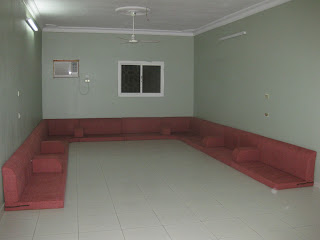 Yes, mashaa'Allah, the room is very large and can easily accommodate 30 or more people. The seating is called masnad seating, being like a firm fitted sofa that is on the floor. The seating for a room of this size - cost around 2,800 riyal (around US$700/400 UK pounds). Just imagine a couple of laptops perched on the armrests and a few books on the seat beside it and that is pretty much how it looks with everyday use.
This room, and how we live in the house in general, is strongly influenced by Rasool Allah, salla Allahu alayhi wa sallam. He sat on the floor, ate on the floor, and disliked decorations and worldly things. To that end, we made the floor seating, kept the color plain, and chose natural, soft colors of terracotta fabric and sage green walls. All four bedrooms have plenty of empty space, as we all sleep on the floor on simple mattresses with just the necessary storage to keep clothes and things organized.
The thing we have the most of is books and kitchen things. We have the books because knowledge is paramount, followed of course with action, da'wah, and patience. As for the kitchen things, we cook and entertain groups of up to 40 - 50 people at times and we don't use disposable items so we have enough stainless steel platters, bowls, cups, and cutlery to accommodate everyone...and a few big pots! We have hand woven mats made from date palm leaves that we put down on the floor when we eat and large stainless steel platters so that several people can eat from the same plate.
We have no television, no fancy bought rugs, wall units, coffee tables, although we have computers (of course) and a CD/tape player for playing Qaidat an Nooraniyah tapes, Quran, and lectures.
 Above is our local masjid, which is literally outside our front gate, across the street and over that dirt lot; it is 129 meters from our house, mashaa'Allah. I see those mountains against a varying backdrop of sky every time I look outside or go to the roof to do the laundry.
It is 5 miles/ 8.29 kilometers from our house to Masjid an Nabawi.
Our little "escape" to get in touch with fresh air, camping, and nature is no further than our front courtyard - our "khayma" or tent. We sometimes have a barbeque and eat dinner out there on pleasant evenings. As a fun treat, we all camp out in the tent on weekends. It is used as a clubhouse for hubby and his friends from the Islamic University of Madinah and his colleagues from Taibah University. We even piled about 30 girls and women in there on one of our monthly girls' reading club nights.

Our little planted patch of green with three date palms, has benefited from some permaculture practice. We spread two bales of straw on the sandy, cracked, and dry-looking soil that the date palms, a lemon tree, and some fragrant bushes are planted in.

We also set up a compost heap. The straw has turned everything around, subhaan Allah. It retains moisture and keeps the moisture in the soil, so things are growing like wildfire out there now, mashaa'Allah. We have planted melons, all the date seeds that fell last year have started shoots (too many of course, we will have to take them out eventually and give them away or plant them somewhere else.)

There are no worms here, but another University professor brought some in and gave us some, so we introduced them to our compost heap about two weeks ago. Inshaa'Allah, it will be something to behold how they get on in there. For all the extreme heat and aridity, our little patch of green has become the "place to be" for families of sparrows and busy little bees buzzing from flower to flower in the date spadix.


This post has been a long time coming, and perhaps you will like or dislike our lifestyle depending on your tastes and preferences, but I ask that you please say upon seeing this glimpse, "Mashaa'Allah, tabaarak Allah" (With the will of Allah, and with His blessings).
Barak Allahu feekum, dear readers.
Our home is not typical of homes here...well, the actual house is perfectly common, but how we live in it is not. This is our ladies sitting room/family room.

This room, and how we live in the house in general, is strongly influenced by Rasool Allah, salla Allahu alayhi wa sallam. He sat on the floor, ate on the floor, and disliked decorations and worldly things. To that end, we made the floor seating, kept the color plain, and chose natural, soft colors of terracotta fabric and sage green walls. All four bedrooms have plenty of empty space, as we all sleep on the floor on simple mattresses with just the necessary storage to keep clothes and things organized.
The thing we have the most of is books and kitchen things. We have the books because knowledge is paramount, followed of course with action, da'wah, and patience. As for the kitchen things, we cook and entertain groups of up to 40 - 50 people at times and we don't use disposable items so we have enough stainless steel platters, bowls, cups, and cutlery to accommodate everyone...and a few big pots! We have hand woven mats made from date palm leaves that we put down on the floor when we eat and large stainless steel platters so that several people can eat from the same plate.
We have no television, no fancy bought rugs, wall units, coffee tables, although we have computers (of course) and a CD/tape player for playing Qaidat an Nooraniyah tapes, Quran, and lectures.

It is 5 miles/ 8.29 kilometers from our house to Masjid an Nabawi.
Our little "escape" to get in touch with fresh air, camping, and nature is no further than our front courtyard - our "khayma" or tent. We sometimes have a barbeque and eat dinner out there on pleasant evenings. As a fun treat, we all camp out in the tent on weekends. It is used as a clubhouse for hubby and his friends from the Islamic University of Madinah and his colleagues from Taibah University. We even piled about 30 girls and women in there on one of our monthly girls' reading club nights.

Our little planted patch of green with three date palms, has benefited from some permaculture practice. We spread two bales of straw on the sandy, cracked, and dry-looking soil that the date palms, a lemon tree, and some fragrant bushes are planted in.

We also set up a compost heap. The straw has turned everything around, subhaan Allah. It retains moisture and keeps the moisture in the soil, so things are growing like wildfire out there now, mashaa'Allah. We have planted melons, all the date seeds that fell last year have started shoots (too many of course, we will have to take them out eventually and give them away or plant them somewhere else.)

There are no worms here, but another University professor brought some in and gave us some, so we introduced them to our compost heap about two weeks ago. Inshaa'Allah, it will be something to behold how they get on in there. For all the extreme heat and aridity, our little patch of green has become the "place to be" for families of sparrows and busy little bees buzzing from flower to flower in the date spadix.


This post has been a long time coming, and perhaps you will like or dislike our lifestyle depending on your tastes and preferences, but I ask that you please say upon seeing this glimpse, "Mashaa'Allah, tabaarak Allah" (With the will of Allah, and with His blessings).
Barak Allahu feekum, dear readers.
Subscribe to:
Posts (Atom)